
On December 23, 2025, the Bay Area Air District (BAAD) announced that the Martinez refinery still is out of compliance with fenceline air monitoring regulations that measure pollution concentrations near its property line. The Air District fined the refinery $20,000 and required it to abide by the District’s tracking rules and provide real-time and historical data to area residents.
Historically, the Martinez Refining Company has been a source of air and water pollution. Concerns about Martinez refinery health threats and what is going to happen next remain high for residents of Martinez and the unincorporated communities of Pacheco, Vine Hill, and Clyde.
Toxins Released at Martinez Refinery
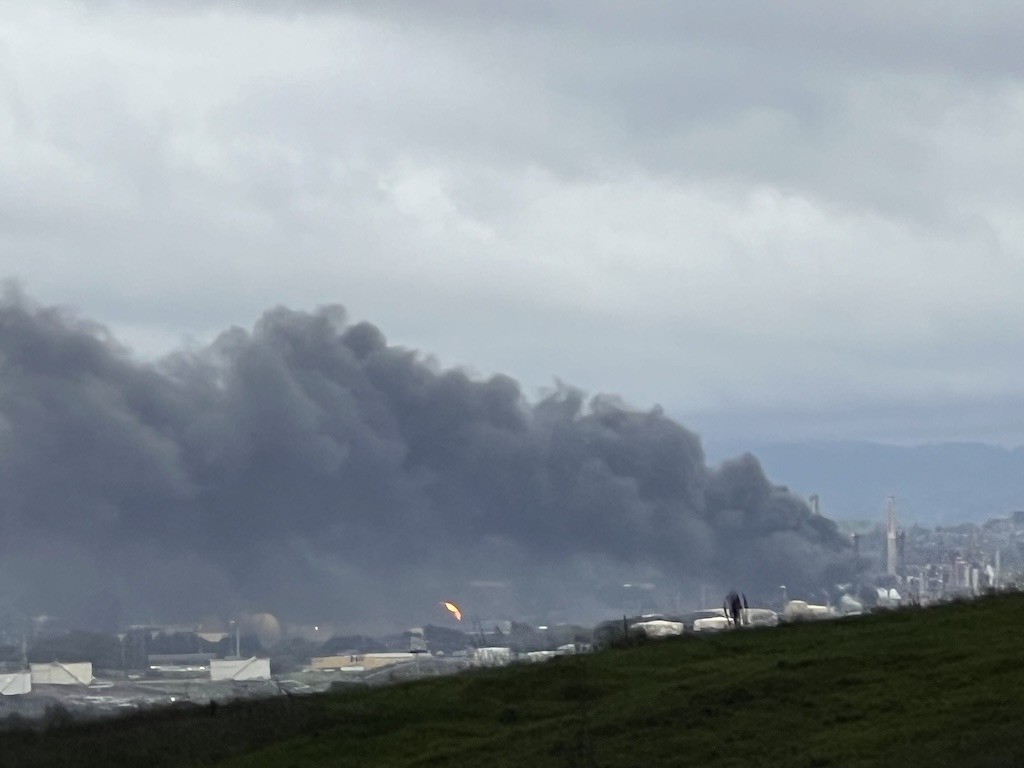
The continued lack of compliance comes after the most recent pollution-heavy incident, which occurred on February 1, 2025, when a fire broke out and burned out of control for several hours. Thick clouds of black smoke containing toxic chemicals and particulate matter blew over the area, mostly north of the refinery.
On February 11, Contra Costa Health issued a press release, later posted on its website, noting that chemicals and combustion byproducts spewed into the air by the fire contained substances that can cause cancer, heart disease, and lung disease. The press release said that toxins released at the Martinez refinery included petroleum and petroleum distillates, and noted that the combustion byproducts, including particulate matter, benzene, hydrogen sulfide, sulfur dioxide, and xylene, posed the greatest health threat. The county initially issued a health advisory to residents of Martinez and the nearby unincorporated communities of Pacheco and Clyde. Then, when the smoke got closer to the ground, ordered people in Martinez north of the refinery to shelter in place.
Radio Incompatibility Delayed County Fire Assistance
On Dec. 9, 2025, Contra Costa County Fire Protection District Deputy Chief Aaron McAlister told county supervisors that the refinery’s lack of radios compatible with the normal county frequency initially left county crews stalled outside the facility.
According to the East Bay Times, this incompatibility delayed the establishment of a unified fire command center by two hours. The refinery does not have a dedicated fire department, as some other refineries do, and relies on cross-trained employees from their fire brigade. It appears likely that speedier county fire assistance could have been helpful.
To correct the radio communications issue, ConFire suggested that employees of the refinery’s fire brigade carry radios that access the county frequency.
Workers Injured, Shelter-In-Place Order
Six workers injured in the fire were sent to a nearby hospital. While County Health lifted the shelter-in-place order later that night, the fire continued to burn until February 4.
As far as long-term health issues, the county press release states that
Air-quality measurements taken by Contra Costa Health’s hazmat staff during the incident showed that concentrations of chemicals in the air during the event were mostly below the threshold considered dangerous. There was a short period when the smoke from the fire stayed closer to the ground and particulate matter immediately north of the refinery measured at a high level, but because that was not sustained over a long period it is not expected to have a significant health impact on most people.
But the county’s bulletin relating to this single event doesn’t show a longer-term picture of the cumulative effect of long-term exposure to industrial pollutants. Research indicates that even short-term, intense pollution exposure can have health consequences.
Data from the American Lung Association shows that short-term and long-term exposure to air pollution causes or aggravates cardiovascular issues, asthma, stroke, and pneumonia, and is linked with a higher risk of lung cancer even in never-smokers.
Martinez City Officials Angry
After the February 1 fire, Martinez city council members, including Mayor Brianna Zorn, and staff expressed strong concerns about the continuing emissions from the refinery. According to a CBS News story, County Supervisor Shanelle Scales-Preston, who represents the unincorporated area where the refinery is located, called for a full audit of the facility. Supervisor Scales-Preston said she was working to find answers to how the fire was caused and how future fires and emissions could be prevented.
After an investigation, human error by two refinery contract workers was determined to be the cause of the fire. According to KQED, the workers were found to have loosened the wrong flange on the wrong side of an isolation unit, causing an ignition from the release of flammable hydrocarbon material. Inadequate training and supervision of the workers was determined to be the cause of the fire.
Other Recent Toxic Emissions
Between 2018 and 2022, BAAD fined the Martinez refinery $5 million for multiple air quality violations, mostly for flaring rather than processing vapors and gases, including sulfur dioxide, hydrogen sulfide, and particulate matter. The State Water Resources Control Board also fined the refinery $4.5 million for discharging millions of gallons of wastewater into the nearby marshes in 2022 and 2023.
Additionally, on Thanksgiving Day, in November 2022, the refinery released about 20 tons of toxic spent-catalyst metallic dust onto the surrounding community. After belatedly warning residents that the dust was dangerous, the refinery advised them not to grow or eat crops in the soil where the dust had fallen. Six months later, a toxicologist hired by the county determined that the release did not “increase exposure of hazardous metals in local soils,” as the quantities of hazardous metals where the dust fell were within the range of quantities found throughout the state.
Toxic Metals in Our Soil
This raises but does not answer questions about the safety of local soil for agriculture or home gardening. A related Contra Costa County health press release states that “the soil testing did underscore that metals in the ground are a fact of life in developed areas like Contra Costa with heavy industry and agriculture.”
The release further states that metals found in the samples tested included lead and arsenic, but indicated that the amounts were no higher than in soil areas not involved in the refinery release. The county states that “there is no absolute safe amount of arsenic that humans and animals can ingest,” but said most edible plants don’t absorb enough to be a “health concern.” County Health Officer Dr. Ori Tzvieli said in that press release that if people are concerned about toxic metals in their soil, they can use clean, store-bought soil to grow food in their yards.
Get Involved for Cleaner Air in Martinez
Want to get involved in promoting cleaner air in Martinez? Martinez residents face shelter-in-place orders with unnerving frequency. Three ways you can act:
Learn more about the history of emissions from the Martinez Refinery, and stay up to date about current monitoring measures, at the city’s Martinez Refining Company Oversight Webpage.
Get information about Healthy Martinez, a local grassroots refinery accountability group.
Join 350 Contra Costa Action (350 CCA) in pursuing clean air and soil in Martinez. Volunteer with us. We have many roles for concerned citizens. And if you’re ready for a deep dive, become a 350 CCA Martinez city liaison.
Published Feb. 15, 2026
Image credit: Christine Stevens