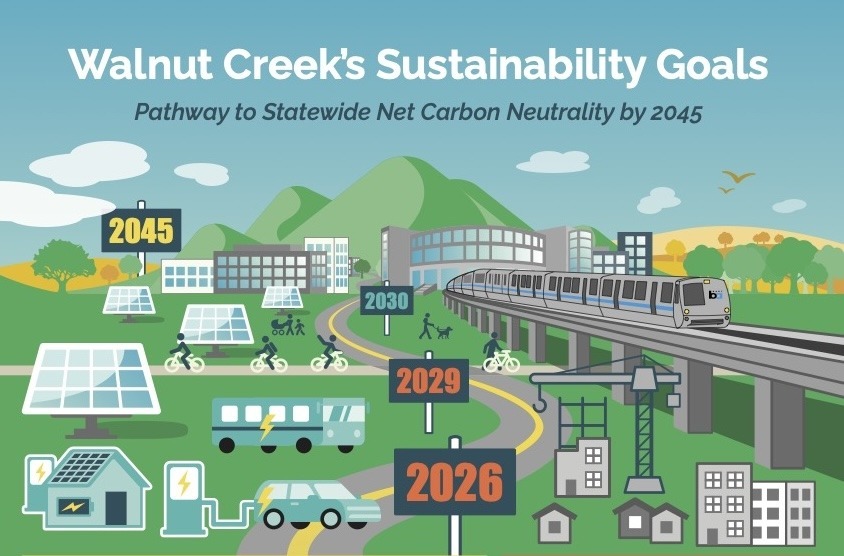
What will Walnut Creek look like in 2030? Maybe you’ll notice quieter streets and fewer exhaust fumes as more bicycles and electric vehicles replace gas-powered cars. You’ll spot more solar panels glinting in the afternoon sun, and see neighbors swapping worn-out gas water heaters and furnaces for electric heating.
These changes aren’t just a distant vision. Step by step, they’ve already begun as Walnut Creek implements its 2023 Sustainability Action Plan—pursuing cleaner air, safer neighborhoods, and a more sustainable future.
Change like this takes time, and results won’t show up right away. Still, the city is making progress:
- Promoting air quality alerts
- Setting up resilience hubs
- Improving disaster readiness and community safety, and
- Boosting energy efficiency in city facilities
While the city has begun implementing some changes, many of these steps will only be getting underway by 2030. It may take years before we see their full impact—especially with some big challenges on the horizon.
National Roadblocks Threaten Progress
National policy remains uncertain. Despite climate concerns, the federal government is increasing support for fossil fuel extraction and use. At the same time, it has suspended incentives for heat pumps, building energy efficiency, rooftop solar, and plug-in vehicles.
These policy changes make it harder for Walnut Creek to reach its clean energy goals. Still, the city is moving forward and making progress toward a more sustainable future.
A Clear Vision: The 2023 Sustainability Action Plan
Even with these challenges, local leaders are working on ways to reduce Walnut Creek’s contribution to climate change and adapt to growing environmental pressures. Building on more than a decade of local climate action, starting with its first climate action plan in 2012, the city adopted a new, three-part Sustainability Action Plan (SAP) in 2023.
This updated plan sets interim milestones for 2026 and 2030, with bigger targets for 2045. It lays out a clear path to lower greenhouse gas emissions and strengthen local resilience, focusing on:
- Cleaner buildings
- Greener transportation
- Smarter water use
- Less waste
The plan was shaped by community input and lessons from past efforts. It aims to speed up progress and respond to new science. But making this vision real will take more than just city leadership.
Broad, sustained action from all of us is needed, even as success remains uncertain. The city can’t make residents and businesses change how they travel or run their homes and buildings. Progress will depend on education, incentives, and encouragement.
This evolving approach reflects both the urgency of climate change and Walnut Creek’s commitment to steady, long-term progress.
Big Goals for 2030: What’s Changing?
On April 1, Walnut Creek took a big step to reduce pollution by banning gas-powered leaf blowers. More changes are coming as the city works toward its 2026-2030 sustainability goals. In the next few years, residents and businesses will see a series of targeted initiatives. These range from updating buildings, supporting all-electric construction, adding more EV charging, and making the city safer and better for biking.
The plan also aims to cut landfill waste, reuse water, and keep Walnut Creek green and livable with new urban forestry efforts. These actions mark the city’s most significant progress so far toward a more sustainable future.
To reach these goals, Walnut Creek is launching the following series of targeted initiatives—each focused on a different aspect of sustainability.
Modernizing Our Buildings
The city encourages residents to upgrade homes and businesses as old systems wear out, choosing energy-efficient electric options. The Bay Area Air District’s (BAAD) proposed ban on the sale of gas water heaters and furnaces, phasing in between 2027 and 2031, will cut nitrogen oxide (NOx) and GHG emissions from these appliances.
However, the Air District is considering delaying this plan, so it is uncertain how quickly Walnut Creek can achieve widespread adoption of electric replacements.
As Walnut Creek Sustainability Manager Candice Rankin Mumby recently explained, “We are focusing our building electrification efforts on implementation of the Air District’s Rule 9-6 related to zero NOx water heaters, and on promoting BayREN and MCE programs.” She added, “We are tracking BAAD’s deliberations on the timing and will continue promoting the benefits of heat pump water heaters in the interim.”
Expanding Electric Vehicle Charging
To support the gradual shift to electric vehicles, the city plans to add 40 publicly accessible EV charging stations on city property by 2030 and 90 by 2045.
Building a Bike-Friendly City
The city plans to expand its bike lanes by 25 percent to make biking easier for more people. Still, big changes in how people get around will take ongoing effort and a shift in culture.
Cutting Waste
Walnut Creek aims to keep 75 percent of waste out of landfills by 2030 by encouraging more recycling, composting, and creative ways to reduce waste. Achieving this will be challenging and depends on community-wide participation.
Reusing Water Wisely
Working with the Central Sanitary District, the city will expand recycled water systems and cut outdoor water use across Walnut Creek by 15 percent. While we could not find information about their water recycling program, we learned that the city is implementing drought-tolerant measures to reduce water use.
Greening Our Community
A new citywide tree plan will guide how Walnut Creek plants and cares for its trees, helping keep the city cooler and more comfortable as the effects of climate change intensify.
It Takes a Village
The Sustainability Plan is a comprehensive set of goals, rather than a step-by-step manual. Reaching these takes strong community involvement at every step.
Sustainability plays a central role in decisions about budgets, capital projects, and other city plans. The city asks for and values community input throughout the process.
City staff work with residents, businesses, and groups to create and run programs that help Walnut Creek move forward. City leaders track progress, but success depends on everyone’s participation, even as outside factors affect the outcome.
The level of success will depend on government mandates and incentives, and on the extent to which individuals, businesses, and agencies voluntarily take action to promote greater sustainability, both locally and around our planet.
What Can You Do?
Taking local action may seem small compared to global climate problems. But every effort, like threads woven together, helps build a stronger, more resilient community. And individuals’ efforts to live more sustainably can encourage governments and businesses to do the same. Here are some ways you can help:
- Stay informed: Visit the City’s ECO homepage for updates and resources.
- Make sustainable choices at home and work, such as using less gasoline and natural gas, cutting water use, recycling more, or trying other ways to get around.
- Get involved in local programs, public workshops, or community clean-ups.
- Create a Cleaner Contra Costa account to track your sustainability goals and compete with neighbors and friends.
- Organize a block party or host a Sunday supper to connect with neighbors and encourage support for Walnut Creek’s green initiatives.
- Attend a city council meeting and share with your elected leaders how important environmental protection is to you.
- Become a 350 Contra Costa Action Walnut Creek Climate Liaison.
Every effort matters. When we work together—whether by making changes at home, inspiring neighbors, or stepping up as a Walnut Creek Climate Liaison—we help our city stay vibrant, healthy, and resilient for generations to come.
Pub. Jun 24, 2026
Image credit: City of Walnut Creek, used with permission