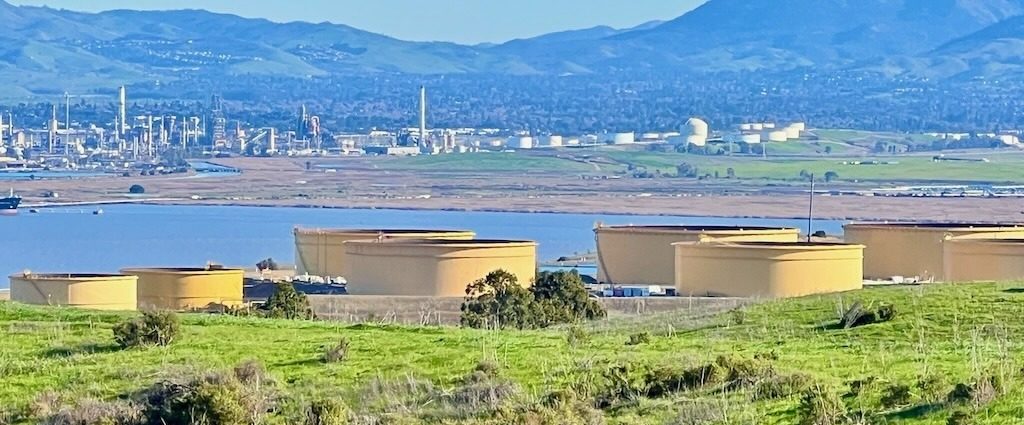
Benicia city officials and residents are worried after learning that the Valero Refinery will begin importing and storing refined gasoline for distribution once it closes in April. City officials were left out of state-level talks about this decision, so Benicia is unsure how the new tank farm status will affect the community.
Valero says the Benicia refinery now makes about 10 percent of California’s gasoline. According to the U.S. Department of Energy Information Administration, the state will lose about 17 percent of its refining capacity with the closure of this refinery and another in Southern California this year. This raises concerns that gas prices in California could go up.
The Valero Refining Company and Gov. Gavin Newsom’s office recently announced that importing refined gasoline for distribution in California should stabilize supply as well as gas prices that would otherwise increase when the refinery stops producing its 145,000 barrels of crude oil per day.
Benicia Refinery to Become Tank Farm
While the Governor’s office and Valero were pleased that importing gasoline to Benicia could help steady supply and prices, city officials were decidely less optimistic about the refinery becoming a ‘tank farm’ that stores large amounts of gasoline.
“I understand on a macro level this is a necessity,” to prevent gasoline price increases and shortages, Benicia Mayor Steve Young said at a recent meeting of the Progressive Democrats of Benicia. “We have empty storage tanks and a deep-water port.” But the mayor also said that the important details have not yet been shared with the city.
Safety Concerns
Young pointed out that the refinery sits on an earthquake fault, and that refined gasoline is much more volatile and flammable than the crude oil currently stored there. “Which tanks?” he asked. “How many tanks? Who will operate it? Will the infrastructure be improved?”
Financial Hardship for Workers and the City
The refinery’s approximately 400 union workers will receive the chance to transfer to other Valero facilities or outplacement job services, according to an NBC Bay Area story quoting a Valero official. It is unclear whether Valero’s contract workers will receive these benefits. Additionally, some Benicia and area businesses are expected to take a financial hit from the refinery’s and its workers’ loss of business.
Economic and environmental questions for the city boil down to “how big and how long” the gasoline importing operation will be, Young said. If the import terminal operates for only two to four years, it will take that long for Valero to dismantle the main refinery before the city seeks another use for the area.
Longer than that could hobble any plans to transition the site to another tax-producing commercial use, which the city needs. Currently, Valero provides about 17 percent of the city’s tax revenues. Stopping production will remove most of that revenue, as production rather than storage is the main source of tax revenue.
Gasoline imports will come through Benicia’s port, which the city has leased to Amports. That lease is set to expire in 2032, and there is discussion of raising port fees to generate more income. However, any significant increase could be said to interfere with interstate commerce, Young said. Complicating matters, the city doesn’t own the port’s land. The city has hired an attorney to investigate these matters.
Concerned? Stay Informed and Talk to Your Elected Officials
Benicia city officials are working to learn more about the Valero Refinery’s new import terminal. If you have concerns about safety, economic, and environmental issues, we encourage you to stay informed and make your voice heard.
- Talk to your elected officials.
- Get notices of upcoming City Council meetings and their agendas.
- Watch for updates about the Benicia refinery in the 350 Contra Costa newsletter and blog, as well as your local news sources.
NOTE: Although Benicia is in Solano County, 350 Contra Costa is reporting on some Benicia refinery and related environmental issues because:
- Cities in Contra Costa County have refineries and may share some common issues in the future.
- Air quality in Martinez and possibly other Contra Costa locations may be affected by the Valero refinery, with only the Carquinez Strait separating the communities, according to the Bay Area Air District.
- The economic fallout from the refinery closure will likely affect Contra Costa County, as some current Valero workers live here.
Published Feb. 18, 2026
Image credit: Christine Stevens